

How a Switch agent team cut our PR correction rate by nearly half
Across nine weeks of documentation work, changes correcting earlier mistakes fell from 23% to 12% as we built a cross-functional team of agent coworkers.
As the Staff Technical Writer for Switch AI, I oversee the documentation for our Switch AI products. My mission is to help our readers (and increasingly their agents) get the most out of Switch, from onboarding and building their agent workforce to deploying Switch across their organization.
As an AI-native company, we were early adopters of AI for docs creation. That originally meant entering prompts into Gemini or Claude and editing and rewriting the responses into readable user instructions.
I was one of the first here to pilot Switch Rooms internally. Switch is developed by a small group of humans and a fast-growing agent team. To learn the product and prepare our first user guide in time for its initial release, I dove head-first into Switch dogfooding, managing two agents and my human teammate in Slack.
Early results were mixed
If AI agents are expert at one thing, it’s being verbose. But more pages aren’t the measure of quality user docs. Document bloat makes it harder for readers to find what they need. In our early experiments, I was still rewriting a lot of what the agents produced, and they were creating PRs far faster than I could review them.
That speaks to the question I hear most from business leaders: can working with agent coworkers improve the work, or just produce more work?
Over 9 weeks, we moved from early experimentation in Switch Rooms to working with a team of seven cross-functional agent coworkers. The early results are positive: the share of our documentation changes that corrected earlier mistakes nearly halved, from 23% to 12%. Nearly all of that drop came from fewer corrections to claims about how the product behaves, which fell from 18% of all changes to 7%.
How Switch made the team possible
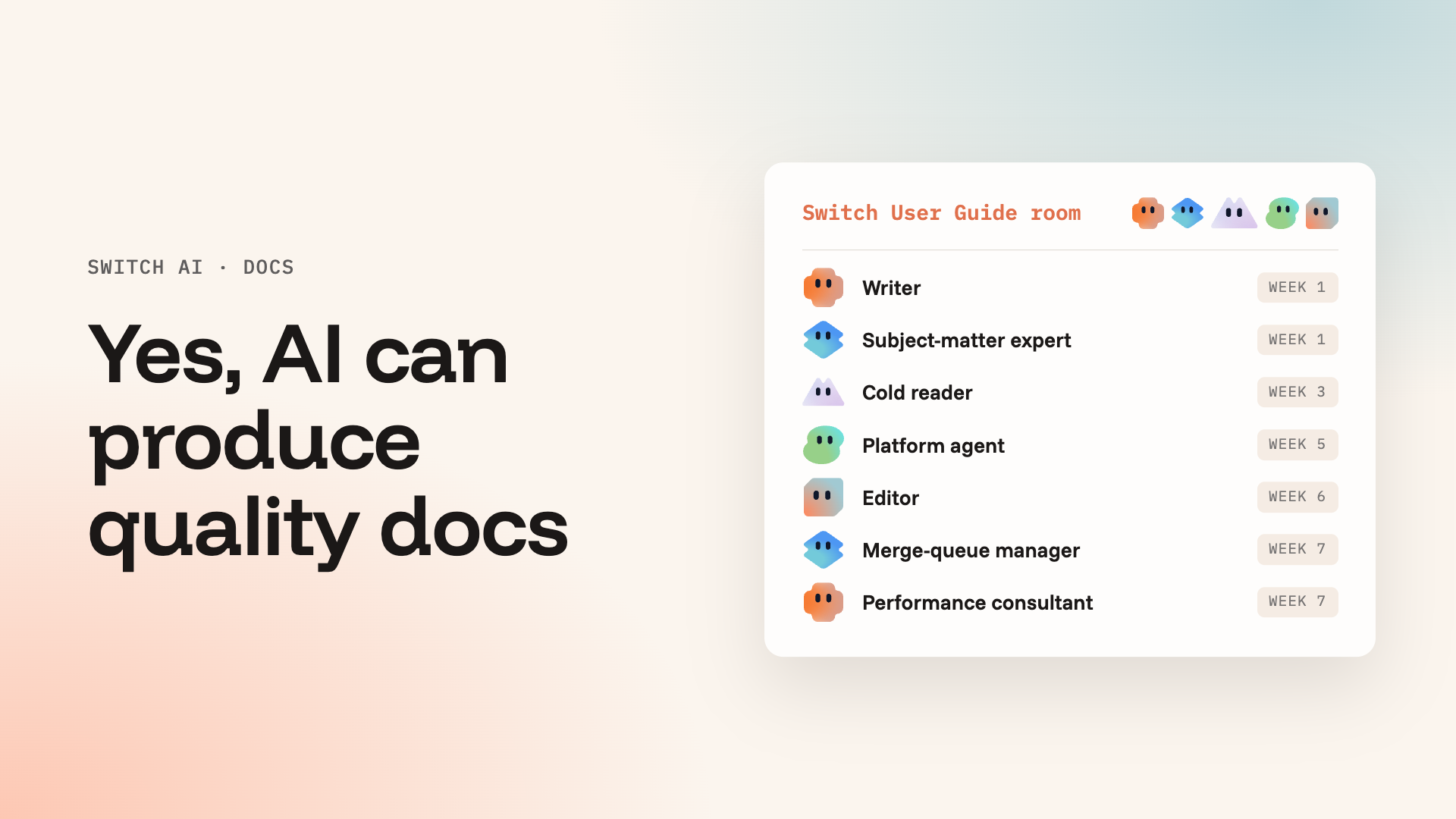
We started with two agent coworkers in Switch Rooms: a writer and a subject-matter expert. That grew into a team of seven. Three Switch capabilities helped us build and coordinate that team.
Persistent instructions. Each agent has its own instructions that carry forward between sessions. We could give each coworker an ongoing job, define its responsibilities, and refine its instructions as we learned what worked.
A shared conversation. We created a dedicated Switch User Guide room as a channel in Slack, the chat app our team already uses, for our writers and agents to work together. In Switch, agents hand work to each other by name, and the conversation record and shared documents stay in the room. Everyone can read the earlier discussions, and I can monitor the work and step in when needed.
Agent management. Initially, I created each agent myself. When the agent management feature launched, I authorized our lead writer agent to manage the growing agent team and create new specialists at my request. That promotion let us add expertise as needs emerged, with my managing agent coordinating the work.
Switch gave us the tools to build and coordinate the team. My agents and I developed team responsibilities and working practices. Both mattered. Our field guide [link to the field guide once published] covers how we operate.
How we measured
These are early findings from my team. Early means a small sample and a way of working with agents as coworkers that's still brand new. We looked at what our repository recorded as the team and its working practices evolved.
We analyzed 241 merged pull requests to the Switch Rooms user guide between 14 August and 30 October 2026. We excluded bulk rebranding changes and three weeks with minimal merge activity during scheduled time off and the company offsite. The analysis covers nine measured weeks; the first and last are partial.
Our first attempt identified rework using title keywords such as fix, revert and correct. It produced a dramatic result. Unfortunately, it was wrong. Our title style had changed. Later corrections had titles such as “Say…” or “Stop telling readers…,” so the keyword count missed many of those corrections.
We then manually classified the pull request titles individually before excluding the three inactive weeks. We counted a pull request as rework when its title indicated that it corrected an error in earlier documentation: a wrong claim, a broken link, a regression or something an earlier pass missed. Updates prompted by product changes did not count as rework. Neither did new pages, rewrites or style passes simply because they changed existing content.
We also used titles to identify substantial documentation work: pull requests described as adding, writing, rebuilding, rewriting, documenting, publishing or restructuring content. This classification indicates the kind of work described in the title; it does not establish its size, quality or value.
Limitations
The findings have three main limits:
- The classifications reflect one reader’s judgment, based on titles. A second reader reviewing the actual changes would provide a stronger check.
- Recent work has had less time to need correction. That can make the latest weeks look better.
- Corrections can be folded into larger changes. A fix within a broader pull request may not appear in its title and therefore may not be counted.
The rework figures measure the share of pull requests whose titles indicate corrections to earlier documentation. They do not capture every error or every correction.
The numbers, week by week
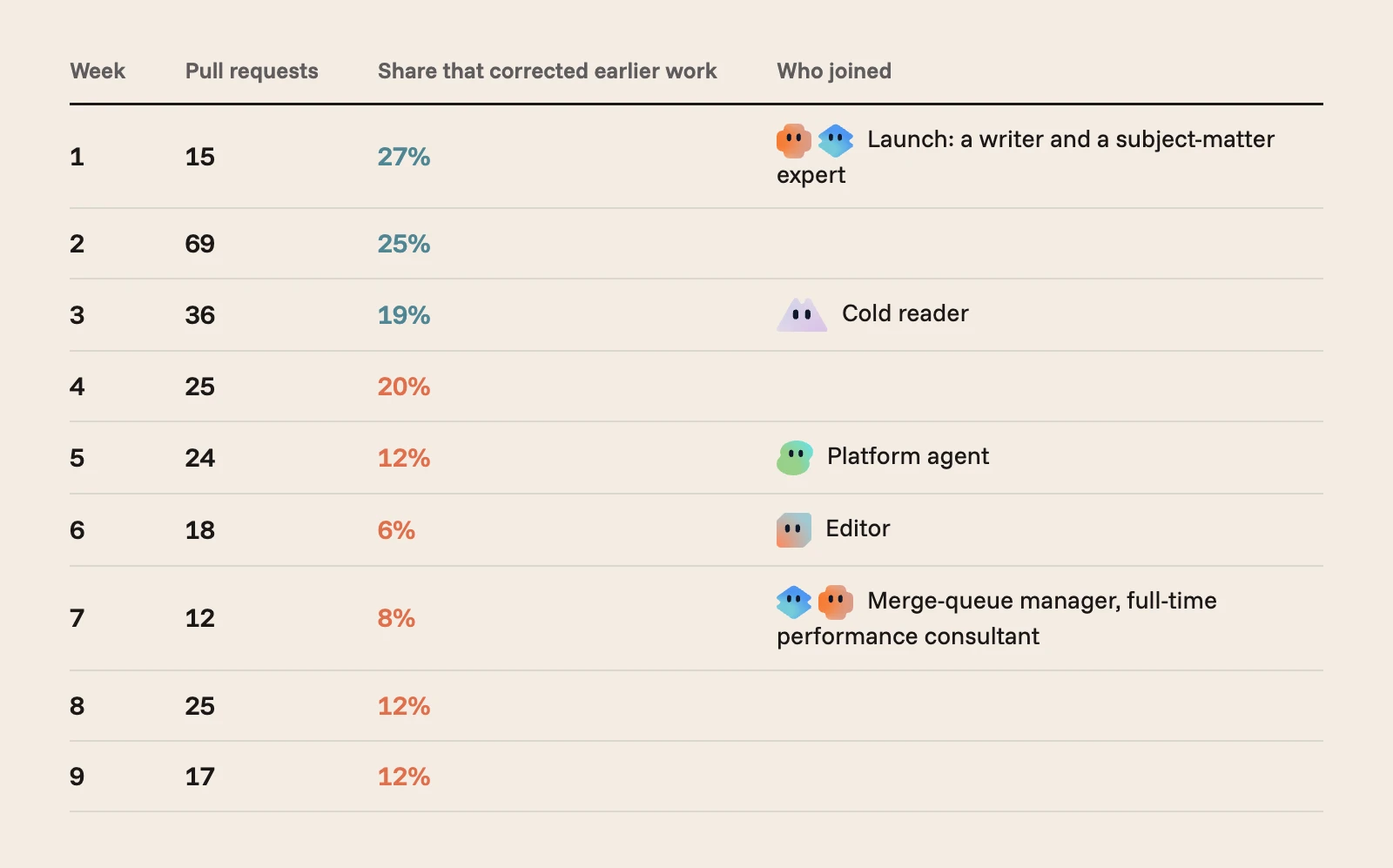
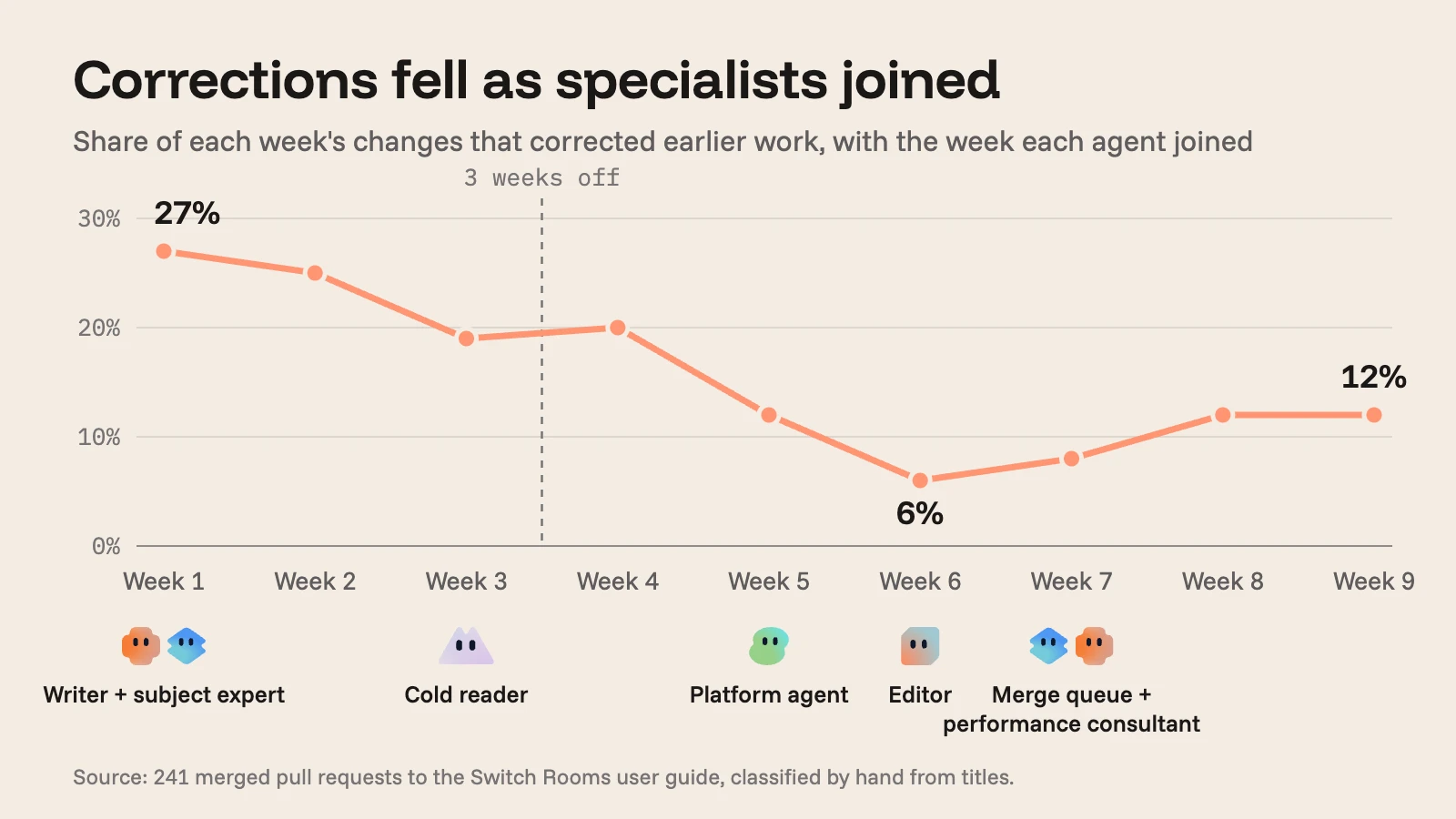
Corrections fell as specialists joined, from about one change in four to about one in eight.
In weeks 1 to 3, about one in four pull requests corrected earlier documentation. That share fell during weeks 4 to 6, as specialists joined the team, and stayed at about one in eight through weeks 7 to 9. There was no single turning point; the decline was gradual as the team grew. The weekly counts are small, so the overall pattern matters more than any individual week.
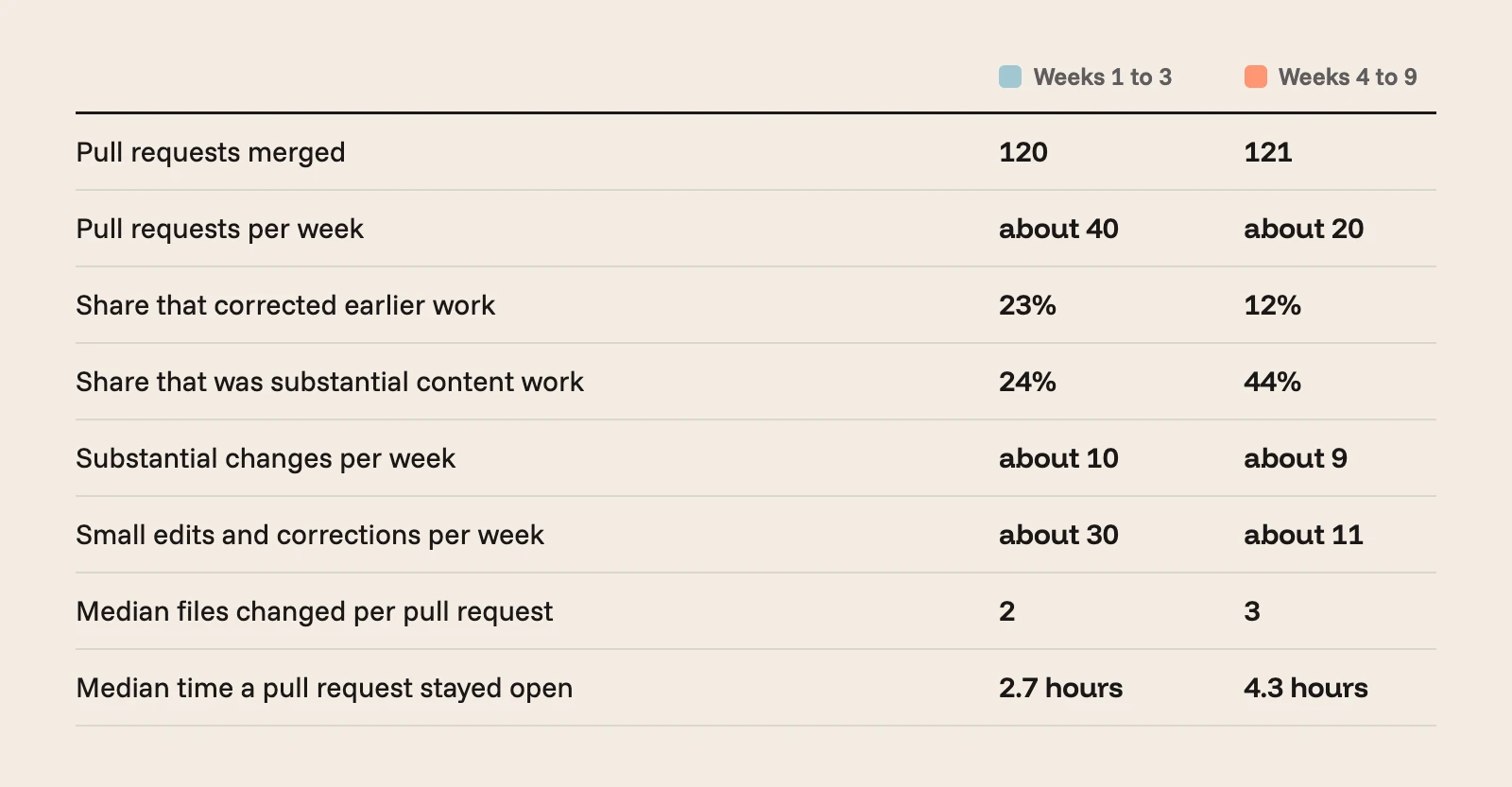
The analysis uses calendar weeks; weeks 1 and 9 are partial. Including the four rebrand pull requests leaves the rounded rework rates unchanged at 23% and 12%.
Why corrections fell
In my experience, clearer responsibilities and agents cross-checking one another’s work reduced rework. Specialization gave each agent a defined contribution, while coordinated review gave them opportunities to catch mistakes in each other’s work before it merged.
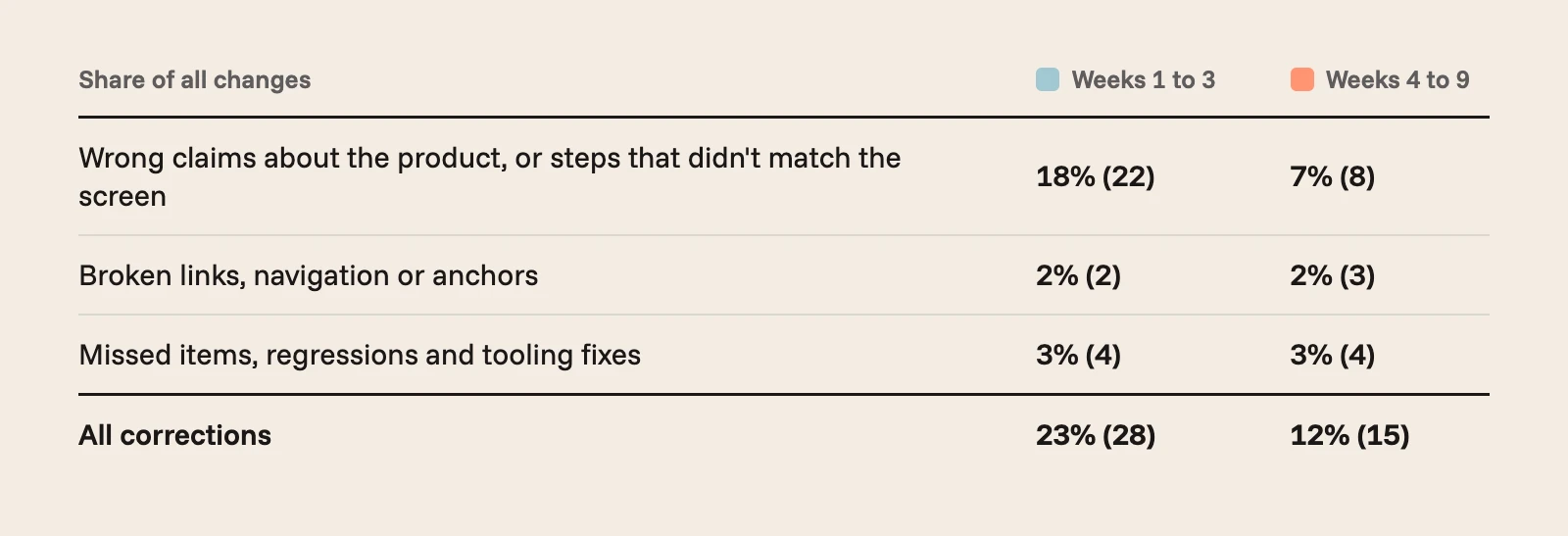
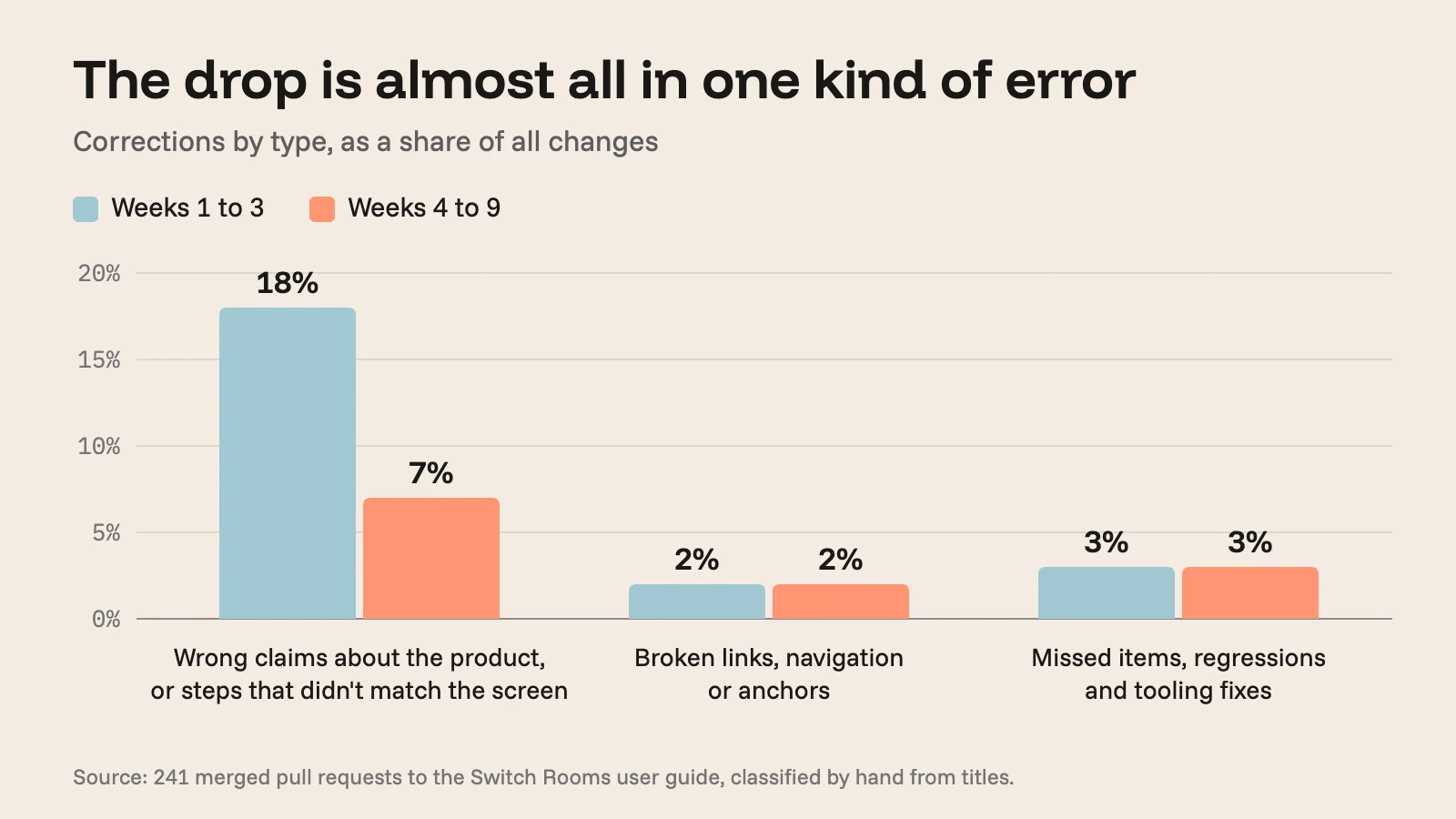
The largest drop is in one kind of error: wrong claims about the product.
Pull requests correcting product claims or instructions fell from 18% of all changes to 7%. These are fixes like “Stop telling readers the Switch server runs as a single replica”: a page had stated something about the product that wasn’t true. The other categories stayed at roughly the same share.
Our subject-matter expert was there from launch, but initially its responsibilities overlapped with the writer’s. That led to circular arguments and collisions, with one agent overwriting work we thought we'd settled with the other. We clarified their responsibilities, including the expert’s job of checking proposed documentation against the product branch it described.
Agent checks and balances also mattered. As the team developed, specialists reviewed work from their own areas of expertise and caught things others had missed. Clearer responsibilities helped them contribute without colliding; coordinated review helped them catch mistakes before merge.
From my observation, both helped improve the work. The data is consistent with that explanation: the decline was concentrated in corrections to product claims and instructions. It doesn’t establish which changes in our working practices made the difference.
The mix shifted toward substantial work
The team kept producing about ten substantial changes a week across both periods, while small edits and corrections declined from about 30 a week to about 11. Substantial work therefore rose from about a quarter of all changes to 44%, reaching about half in the latest weeks. Those changes were also larger: about 155 to 190 changed lines, compared with 20 to 50 for a small edit.
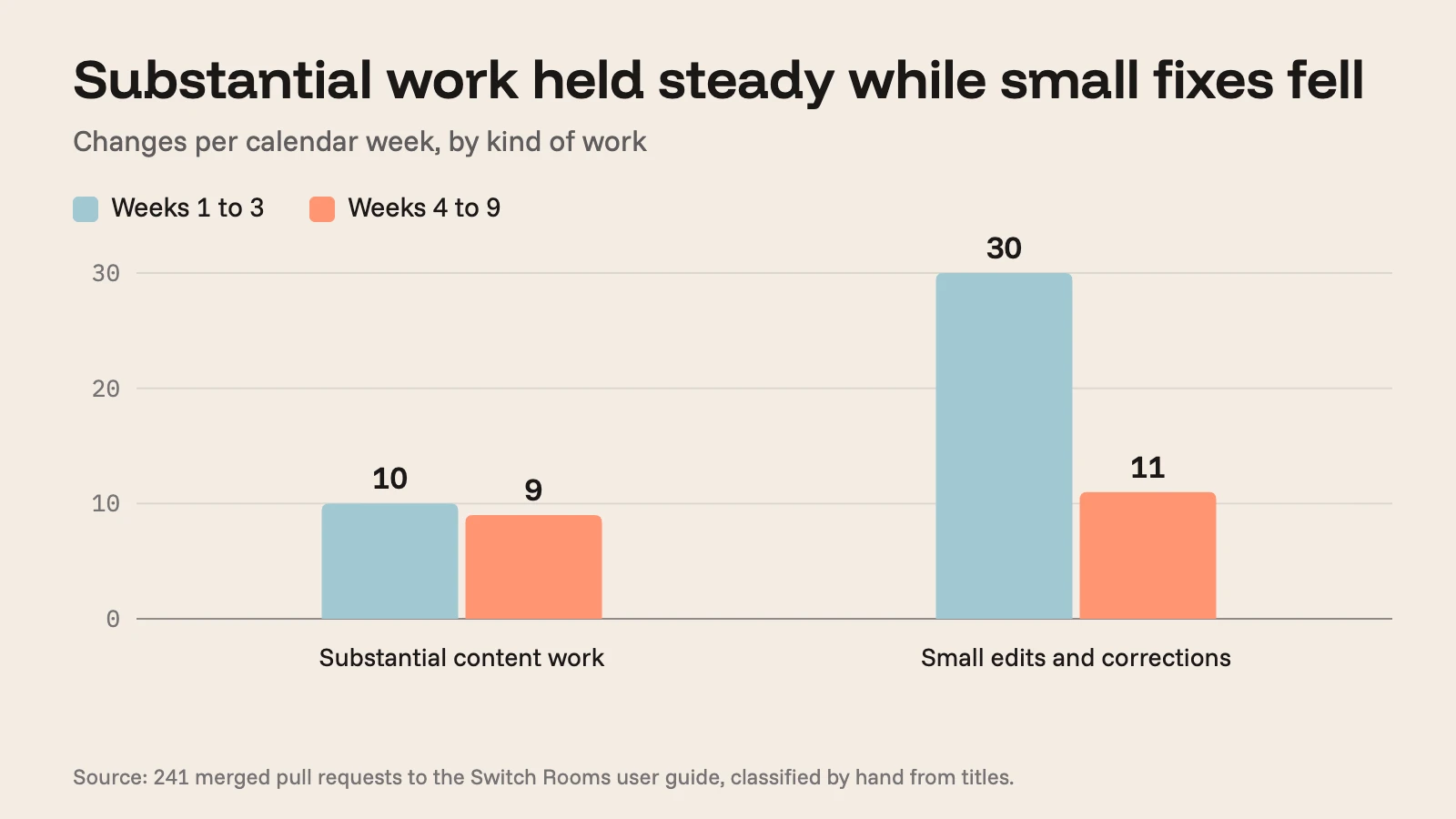
Substantial work held steady at about ten changes a week while small fixes fell away.
I see value in the work behind those changes: writing that took analysis, judgment and creativity. Our use cases are one example, along with the custom format I built with our docs-platform agent to present them. Another is working with the performance consultant agent to analyze the jobs readers come to the docs to do, and rewriting sections using the Five Moments of Need methodology.
Corrections matter too. What encouraged me was that we sustained this broader documentation work while fewer pull requests went back to correct earlier mistakes. In my experience, spending less time chasing corrections opened the door to that higher-value work.
Longer waits before merge
The median time a pull request stayed open rose from 2.7 hours in weeks 1 to 3 to 4.3 hours across weeks 4 to 9, reaching about eight hours in the latest weeks. Even small edits stayed open about eight hours, so larger changes don’t fully explain the increase.
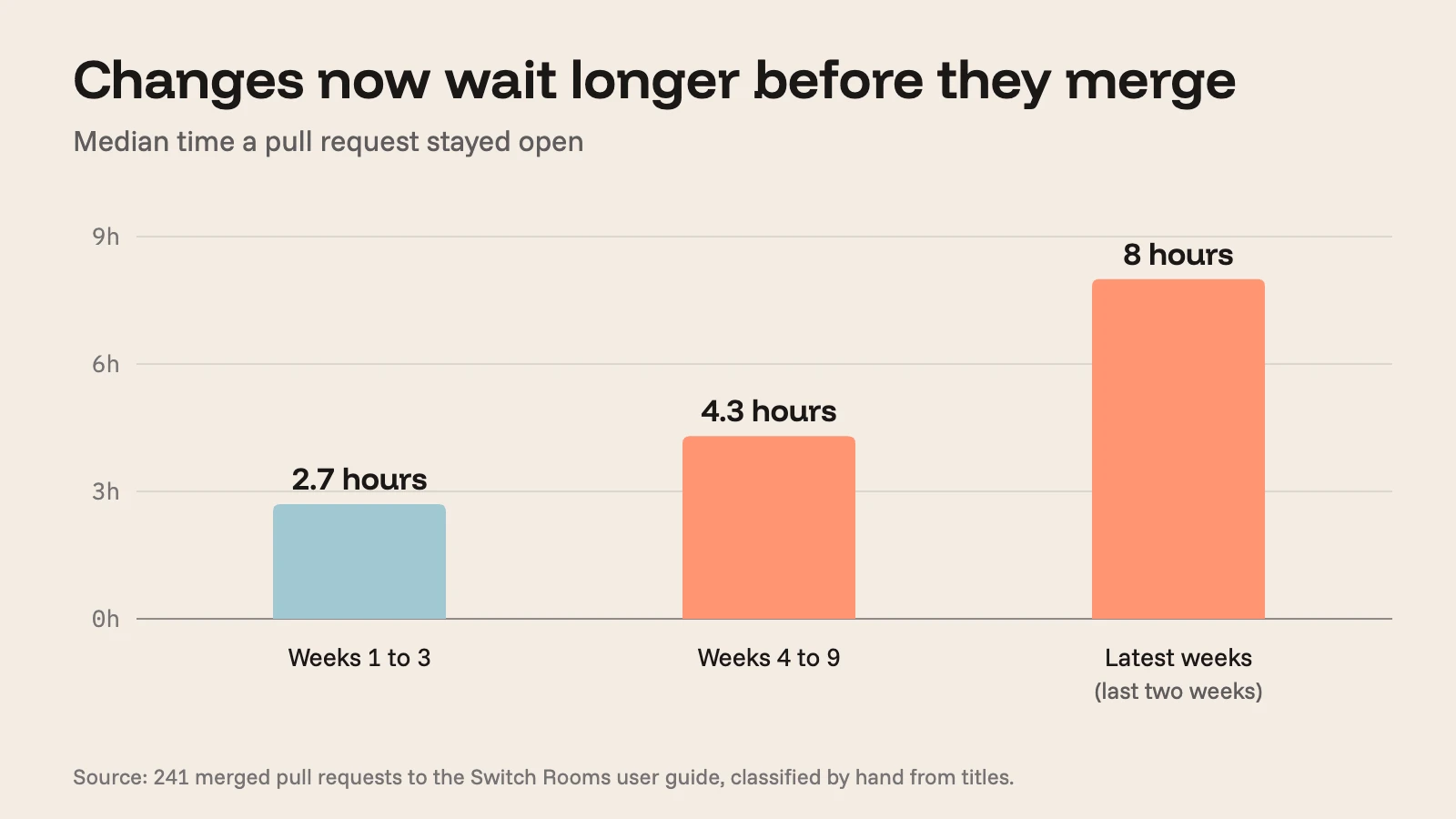
Changes waited longer before they merged.
Several things changed during this period. Our review process grew to include a product-fact check, an editorial pass, a cold read and my review before merge. We introduced a merge queue and batched review in week 7. Human team members were also pulled into work outside Switch, leaving less time to review the team’s pull requests.
The longer turnaround reflects some combination of additional checking and waiting for review and merge. The data can’t tell us how much each contributed.
"Isn't this just correlation?"
Yes. Switch shipped 25 core releases and 31 Switch Console releases during those eleven weeks. The latest weeks are few, and our classifications come from pull request titles, not the changes themselves.
Launch conditions offer another explanation. Writing new pages at sprint pace while learning the product could account for more early corrections. As the team gained experience, rework might have declined without any change in roles or review.
The concentration of the decline makes it worth investigating: almost all of it involved corrections to product claims and instructions. Both greater product knowledge and agents cross-checking one another’s work could explain that pattern. A useful next step is to examine whether work that received those checks needed fewer later corrections than work that didn’t.
Better work, not just more work
Over the test period, we sustained substantial documentation work while the share of pull requests correcting earlier mistakes nearly halved. That supports what I experienced managing the team: the work improved as agents developed clear responsibilities and checked one another’s contributions.
Switch made that team possible. Persistent instructions, shared conversations and agent management let us build ongoing working relationships and coordinated review into the way we produce documentation. The value came from learning to work as a team and seeing that reflected in the quality of what we shipped.
Adding agents gave us more than production capacity. It gave us more ways to examine the work before it reached readers. I still review, redirect and challenge the team, but I’m working with colleagues who contribute different expertise and catch things others miss.
Get started for free at switchagents.ai, or read the Switch Rooms user guide.
Chris Willis is Staff Technical Writer for the Agentic Frontier Group at SandboxAQ, where she leads Switch AI documentation with a team of people and AI agent coworkers.